

Rehearsal room
The rehearsal room plays a planned organisational change against a synthetic workforce. It shows which questions, objections and misunderstandings to expect — before the announcement is made.
You find it on the drafts page below the approval card, once a scenario is selected.
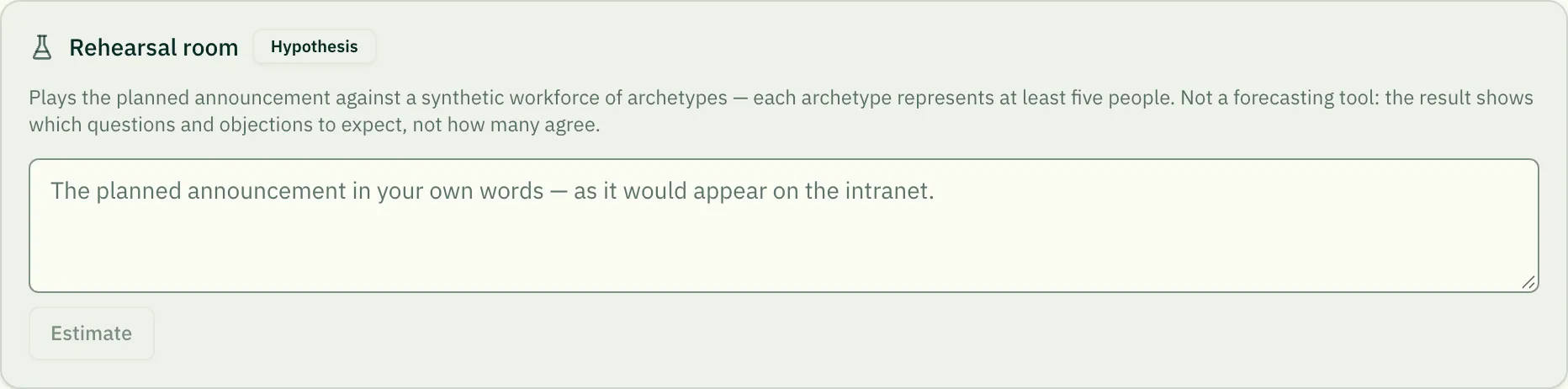
Estimate stays disabled until an announcement is written — and a start button only appears once the estimate is in. The price comes before the click.
What it is — and what it is not
Section titled “What it is — and what it is not”The rehearsal room is not a forecasting tool. It does not tell you how many people will agree, and the interface deliberately never asks that question. Such a number would end up in a presentation, and nobody could say how it came about.
What it does deliver is the role-specific list of what affected people will ask — including the questions of those who are not in the room when leadership meets. Every statement in the report carries its verbatim quote from the transcript.
Nobody is simulated
Section titled “Nobody is simulated”The simulated workforce consists of archetypes. Each archetype represents at least five people; a group with fewer members is not formed but counted and disclosed in the report.
Names, person identifiers and HR master data never leave the platform. This is not a setting you could change: the data structure an archetype is built from has no field for an individual person.
Anonymised interaction signals from Org Intelligence are not used.
The result also has no effect within the system: it produces no draft, no assessment, no metric and no entry attached to a person.
How a rehearsal runs
Section titled “How a rehearsal runs”- Select a scenario. The rehearsal room always rehearses an existing scenario with its drafts.
- Write the announcement in your own words, as it would appear on the intranet.
- Estimate. You see how many archetypes emerge, how many people they represent, how many groups fall below the minimum size, roughly what the run costs and how long it takes. Estimating is free.
- Start. Only now do costs arise. The run takes a few minutes; you can leave the page.
- Read the report. What was missing comes first, then the findings with their quotes.
Two notices the report may give you
Section titled “Two notices the report may give you”“This announcement costs no one anything.” If the announcement contains no job cuts, no relocation and no change to pay, then process questions are the appropriate reaction. An absence of objection then says nothing about your workforce — it says something about the announcement.
“n findings discarded.” Every quote is checked against the transcript. Whatever cannot be found there verbatim is dropped. The number appears in the report so you know how clean the run was.
Limits
Section titled “Limits”- The result is a hypothesis, marked as such. It names the model used and the assumptions it was produced under.
- A different model yields different results — not merely better ones. That is why the model is named in the report.
- Institutional reactions are not modelled. A works council issuing a statement is a procedure, not an archetype.
- Runs are capped per month, and there is a minimum interval between two runs.
Who may do what
Section titled “Who may do what”| Permission | Meaning |
|---|---|
foresight:read | Read reports. Granted to anyone who can see the scenario. |
foresight:run | Start or cancel a run. A run costs money. |
The rehearsal room is a subscribable feature. If it is not booked, the section does not appear.